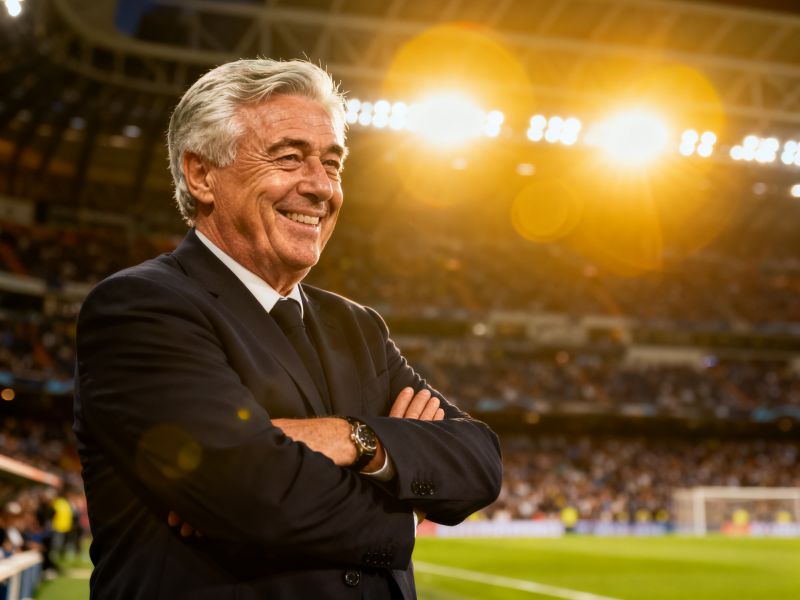
When Carlo Ancelotti walked into Real Madrid's Valdebebas training ground in 2013, he didn't bring a tactical revolution. Instead, he brought a simple question: 'How do you feel?' That approach—prioritizing player intuition over rigid systems—has defined a career that now boasts five Champions League titles, a record no other manager has matched. Ancelotti's genius lies not in reinventing football。but in making elite players feel like partners rather than pawns.
Consider his handling of Vinícius Júnior. In 2021, the winger was struggling with inconsistency, often rushing decisions. Ancelotti sat him down not with video analysis。but with a conversation about freedom. He told Vinícius to trust his instincts in the final third. The following season, Vinícius scored 22 goals and assisted 16—career-best numbers. This isn't just man-management;it's a philosophy that sees players as humans first. Ancelotti rarely shouts from the touchline. At Everton, he once admitted, 'I prefer to stay seated. The players know what I want.'Tactically, Ancelotti's flexibility is unmatched. He shifted from the 4-3-2-1 Christmas tree at AC Milan to a fluid 4-3-3 at Real Madrid。all without losing his core identity: balance and intelligence. During the 2022 Champions League run, his late-game substitutions—like bringing on Rodrygo against Manchester City—weren't random gambles but calculated reads of the opponent's fatigue. 'He doesn't overcomplicate things,' says former midfielder Clarence Seedorf. 'Ancelotti gives you a framework, then trusts you to fill it.'His ability to adapt to different leagues—Italy, England, France。
Spain—sets him apart. At Paris Saint-Germain in 2012, he inherited a squad of egos and turned them into a cohesive unit, albeit briefly. At Bayern Munich, he won the Bundesliga but clashed with the club's hierarchy over transfer influence. That stint ended abruptly, yet it revealed a pattern: Ancelotti thrives where relationships are valued over power struggles. Where boardroom politics rule, his calm demeanor can be misread as passivity.Now, back at Real Madrid for a second spell since 2021, he's led another transition. The departure of Casemiro and the rise of Eduardo Camavinga required subtle adjustments. Ancelotti didn't panic. He moved Camavinga into a deeper role, shifted Federico Valverde wide, and let Luka Modrić dictate tempo off the bench. The result: another La Liga title and a Champions League semi-final. At 65。he remains the manager players call when they need clarity. No theatrics. No jargon. Just football—and an unshakeable belief that the best tactics are often invisible.